Skip to content
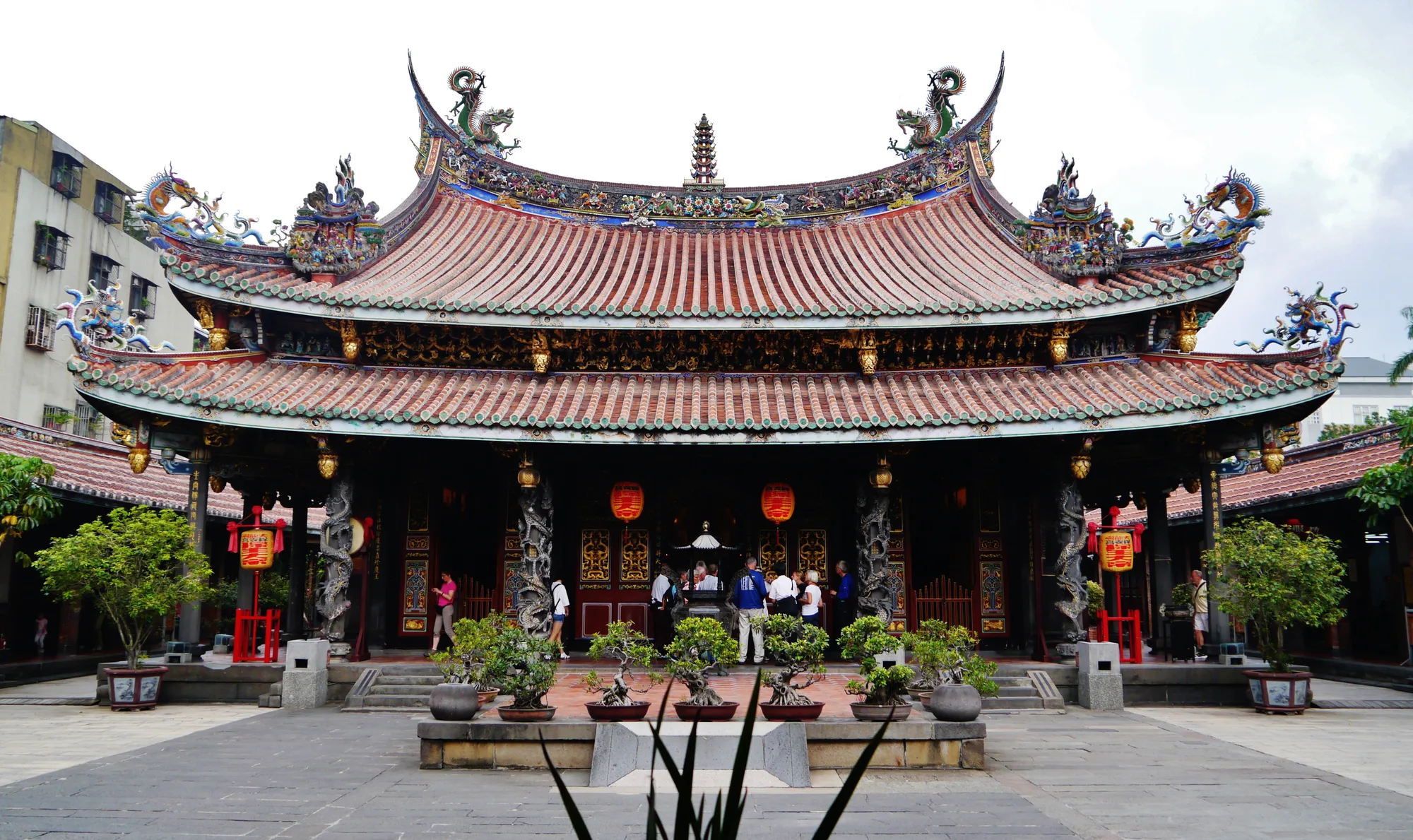
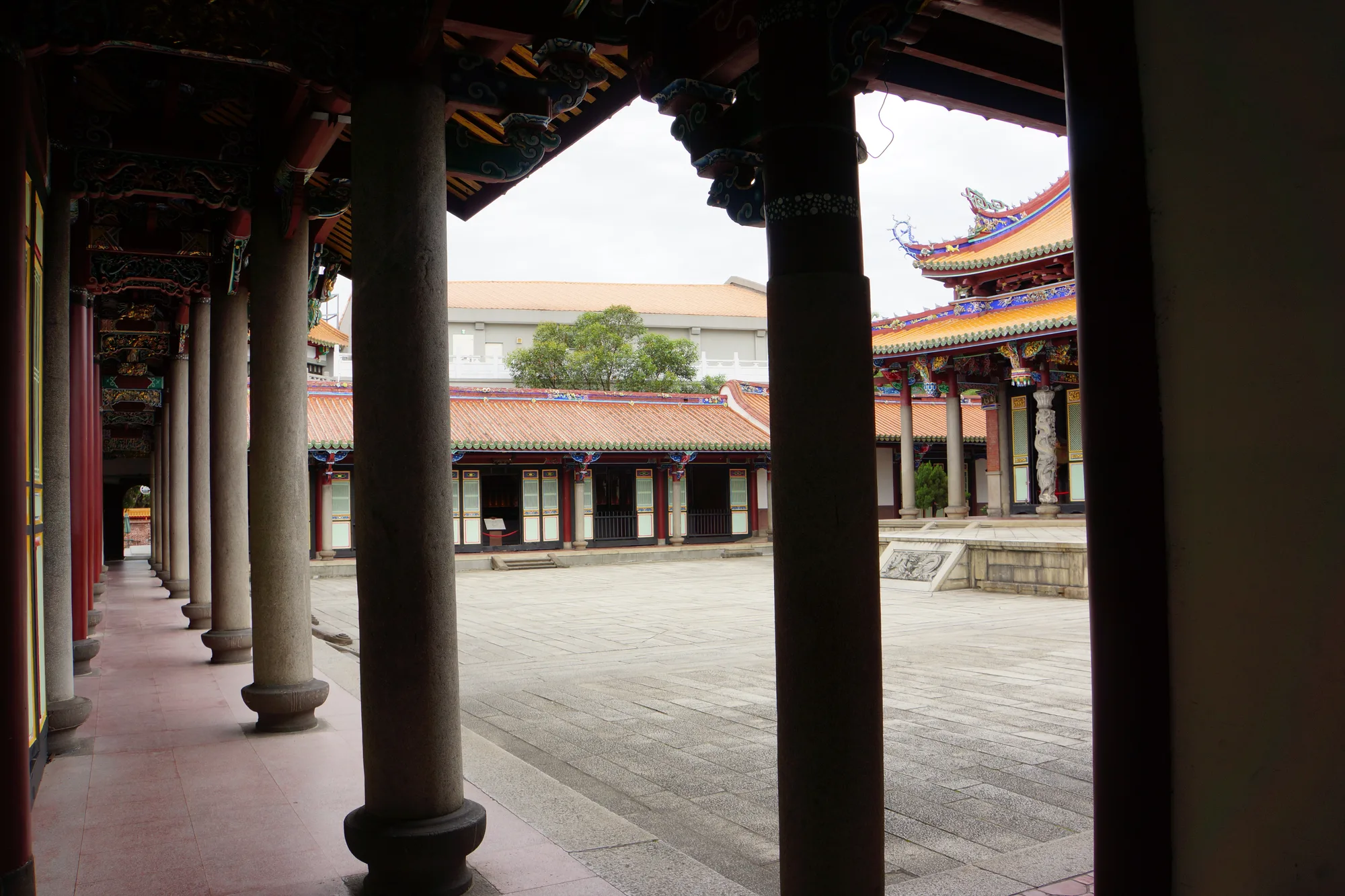
The inner courtyard and colorful tiled-roof halls of the Taipei Confucius Temple
Taipei · 台北 · 25.03°N 121.56°E

Taipei Confucius Temple: calm courtyards and a quieter temple visit

A calmer, less crowded temple in Datong, first built in 1879 and rebuilt in 1930 in Southern Fujian style—the only Confucius temple in Taiwan decorated with Minnan-style ceramic ornaments. Great when you want culture without the sensory intensity of bigger landmarks.

lienyuan lee · CC BY 3.0

A calmer, less crowded temple in Datong, first built in 1879 and rebuilt in 1930 in Southern Fujian style—the only Confucius temple in Taiwan decorated with Minnan-style ceramic ornaments. Great when you want culture without the sensory intensity of bigger landmarks.

Updated June 20, 2026

Map

Visualize where this fits in your day (and plan nearby pairings).

Open full map →

Quick facts資訊

Cost
Free
Hours
Tue–Sun and national holidays 08:30–21:00; closed Mondays
Time needed
45–60 minutes
Getting there
MRT Yuanshan (Red Line), Exit 2, about a 10-min walk
Best time / for
Weekday daytime; the annual Confucius Birthday Ceremony on 28 September (Teacher’s Day) is the major event but extremely crowded and ticketed
Good to know
Closed every Monday (unlike neighboring Baoan Temple); note the roof carries no inscriptions, in keeping with Confucian humility.
District
Datong
Best for
Quiet culture, architecture, a calm walk
Closed
Mondays

Highlights亮點

  • A quieter, more contemplative temple experience
  • Rare Southern Fujian (Minnan) ceramic ornamentation
  • Sits beside Baoan Temple for an easy two-temple loop

Why go

If you want a temple visit that feels calm, this is a good pick. The atmosphere tends to be quieter than the city’s busy folk temples, and the experience leans toward courtyards and observation rather than crowds. It’s a nice counterpoint to ornate temples: more measured, more spacious, and easy to appreciate even with limited time.

There’s real history here too. The original temple was built in 1879 during the Qing Dynasty, then rebuilt in 1930 under craftsman Wang Yi-shun and modeled after the original Confucius Temple in Qufu, Shandong. It sits at No. 275, Dalong Street in Datong District and is operated by the Taipei City Government.

What makes it distinctive

The temple is built in Southern Fujian (Minnan) style, and it’s the only Confucius temple in Taiwan decorated with southern Fujian-style ceramic ornaments—a detail worth slowing down for as you move through the halls.

One quiet but telling feature: there are no inscriptions on its roof, a deliberate gesture of Confucian humility. Small touches like this reward visitors who look closely rather than rushing a single loop.

  • Southern Fujian (Minnan) architectural style
  • The only Confucius temple in Taiwan with Minnan-style ceramic ornaments
  • No roof inscriptions—an expression of Confucian humility
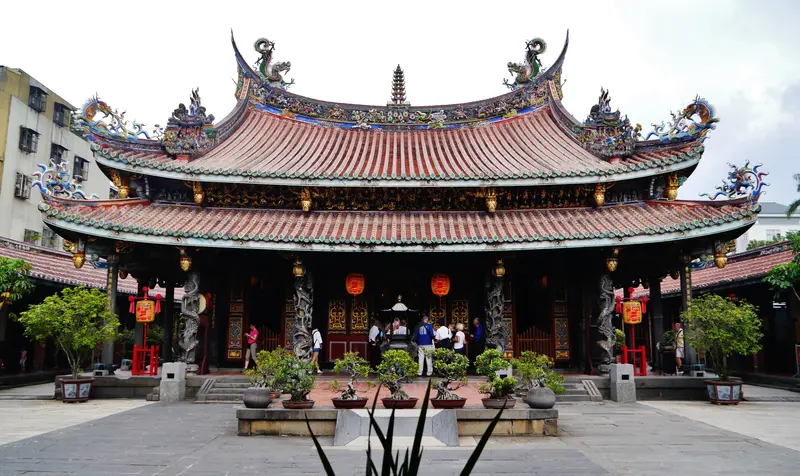
The inner courtyard and colorful tiled-roof halls of the Taipei Confucius Temple
Photo: lienyuan lee · CC BY 3.0 · Wikimedia Commons

How to visit

Treat it like a slow walk. One loop, a few minutes of stillness, then continue your day. Temples are best when they fit your energy level, not when you force them into a checklist. Keep photos respectful and avoid flash.

Mind the schedule: the temple is open Tuesday to Sunday and on national holidays from 08:30 to 21:00, and it closes every Monday. The big annual event is the Confucius Birthday Ceremony on 28 September (Teacher’s Day)—impressive, but extremely crowded and ticketed.

  • Go in gentle light (morning or late afternoon)
  • Closed Mondays—plan around it
  • The 28 September birthday ceremony is ticketed and very busy
The ornate main hall of Dalongdong Bao'an Temple in Taipei, with a multi-tiered swallowtail roof, dragon ornaments and red lanterns
Photo: Zairon · CC BY-SA 4.0 · Wikimedia Commons

What the calm is really like

Where Taipei’s folk temples are alive with incense smoke, fortune blocks, and worshippers murmuring requests, a Confucius temple is built around restraint, study, and respect for scholarship—there are no deity statues to pray to, and the mood is closer to a quiet academy than a bustling place of worship. That difference is the whole point of coming here. After the sensory overload of Longshan or Baoan, the measured courtyards and clean lines feel genuinely restful.

It rewards the kind of visitor who likes to read the architecture. Look for the symbolic details—the dragon pillars, the absence of roof inscriptions, the layout that steps you formally from gate to main hall—and you’ll get far more out of the visit than a quick photo allows. There’s often interpretive signage and the occasional cultural demonstration, so even a short stop can teach you something about Confucian tradition in Taiwan.

How to pair it

This temple pairs best with nearby culture: Baoan Temple sits right next door, and Yuanshan’s museums or a night market finish round out the day. From MRT Yuanshan (Exit 2) it’s about a ten-minute walk. Because the Confucius Temple closes Mondays while Baoan stays open daily, a non-Monday visit lets you do both.

  • Confucius Temple → Baoan Temple loop
  • Confucius Temple → Zhongshan dinner + dessert

FAQ 常見問題

Quick answers to common planning questions.

How long should I budget here?
Forty-five minutes to an hour is plenty for a relaxed loop and a few quiet minutes in the courtyards. Because Baoan Temple is right next door, most people pair the two and spend a gentle half-morning or afternoon in this corner of Datong.
What are the opening hours?
The temple is open Tuesday to Sunday and on national holidays from 08:30 to 21:00, and it’s closed every Monday—unlike the neighboring Baoan Temple, which opens daily.
Is it free to visit?
Yes, general entry is free. Note that the annual Confucius Birthday Ceremony on 28 September is a separate ticketed event.
What’s special about the architecture?
Built in Southern Fujian (Minnan) style and rebuilt in 1930, it’s the only Confucius temple in Taiwan decorated with southern Fujian-style ceramic ornaments. It also notably has no inscriptions on its roof, in keeping with Confucian humility.
How do I get there?
Take the MRT Red Line to Yuanshan station, Exit 2; it’s about a ten-minute walk and sits beside the Dalongdong Baoan Temple.
When is the Confucius Birthday Ceremony?
On 28 September each year, Taiwan’s Teacher’s Day. It’s the temple’s major event but is extremely crowded and requires tickets.

Helpful links 連結

Official pages and references for planning details.

Keep exploring 繼續逛

Hand-picked next reads to make your Taipei plan smoother.

Datong & Dadaocheng: old streets, tea shops, and Taipei heritage

Datong & Dadaocheng: old streets, tea shops, and Taipei heritage

A historic area anchored by Dihua Street—tea, dry goods, traditional shops, and a slower, more photogenic side of Taipei. It’s one of the city’s oldest trading quarters, full of Qing-era and Japanese-Baroque facades that reward a slow, curious wander.

Read more →
Zhongshan: the stylish all-rounder (cafés, bars, easy transit)

Zhongshan: the stylish all-rounder (cafés, bars, easy transit)

A central, design-forward district with great food, cafés, nightlife, and convenient connections—an ideal ‘default’ base for many trips. It blends boutique shopping, art spaces, and a relaxed adult nightlife within easy reach of everywhere.

Read more →
Dalongdong Baoan Temple: ornate craftsmanship in Datong

Dalongdong Baoan Temple: ornate craftsmanship in Datong

A richly detailed folk-religion temple in Datong dedicated to Baosheng Dadi, the deified medicine god—founded by Fujian settlers in 1742 and the only temple in Taiwan to win a UNESCO Asia-Pacific Heritage Award for its restoration. Pair it with the neighboring Confucius Temple for a satisfying cultural loop.

Read more →
Taipei Fine Arts Museum: modern art with park-side breathing room

Taipei Fine Arts Museum: modern art with park-side breathing room

Taiwan’s first museum built for modern and contemporary art, opened in 1983 in a striking white, dougong-inspired building beside Yuanshan’s Expo Park. Home to a 5,000-plus-work collection and the Taipei Biennial—best paired with a park stroll so the day stays spacious and calm.

Read more →
Temples in Taipei: etiquette, timing, and what to notice

Temples in Taipei: etiquette, timing, and what to notice

A respectful, beginner-friendly guide to visiting Taipei’s temples—what to wear, how to move, and how to appreciate the details without feeling awkward.

Read more →
Temples + heritage day: old Taipei, slow streets, and tea

Temples + heritage day: old Taipei, slow streets, and tea

A culture day that feels textured, not heavy: temples and heritage lanes in the morning, tea and old-street browsing in the afternoon, then a gentle dinner.

Read more →

Ready to plan your next stop? 下一站

Start with a simple loop: one neighborhood stroll, one iconic sight, and one night market. Taipei rewards balance.

Tip: hours, prices, and seasonal schedules can change. When something matters (like a museum ticket or a special exhibition), check the official listing before you go.