Skip to content
green and red pagoda temple
Taipei · 台北 · 25.03°N 121.56°E

Qingshan Temple: a heritage temple stop in Wanhua’s older Taipei streets

A historic Bangka temple on Guiyang Street in Wanhua, founded in the 1850s and dedicated to the King of Qingshan, a deity revered for warding off disease. Best paired with Longshan Temple, the Bopiliao heritage lanes, and a snack-heavy old Taipei evening.

A historic Bangka temple on Guiyang Street in Wanhua, founded in the 1850s and dedicated to the King of Qingshan, a deity revered for warding off disease. Best paired with Longshan Temple, the Bopiliao heritage lanes, and a snack-heavy old Taipei evening.

Updated June 20, 2026

Map

Visualize where this fits in your day (and plan nearby pairings).

Open full map →

Quick facts資訊

Cost
Free.
Hours
As an active community temple, it generally welcomes worshippers and visitors during the day; specific hours can vary, so dress and behave respectfully as at any working temple.
Time needed
30–60 minutes.
Getting there
No. 218, Section 2, Guiyang Street, Wanhua District — about 500 meters (a short walk) from Longshan Temple Station (MRT Blue line).
Best time / for
Daytime for the architecture and street texture. For the spectacle, visit during the annual King of Qingshan Festival in the 10th lunar month (typically falling around November).
Good to know
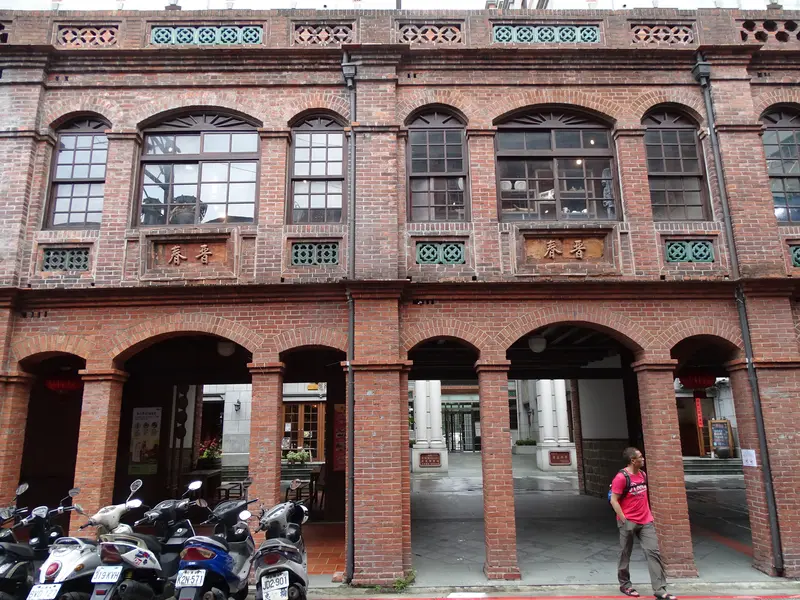
The temple sits among Taishō-era (1912–1925) red-brick shophouses near Qingshui Temple, making the surrounding lanes part of the appeal.
District
Wanhua (Bangka)
Best for
Heritage texture, temple architecture, old Taipei loops
Nearest MRT
Longshan Temple Station

Highlights亮點

  • A historic Bangka temple dedicated to the King of Qingshan (Lingan Zunwang)
  • Home to one of Taipei’s three biggest annual temple festivals
  • Set among Taishō-era red-brick streets near Longshan Temple
  • Easy pairing with heritage lanes and local night-market energy

What it is

Qingshan Temple (Bangka Qingshan Temple) is one of the historic temples of Wanhua, Taipei’s oldest district. It honors the King of Qingshan, also known as Lingan Zunwang, a deity revered for the power to dispel disease and to mete out justice — rewarding virtue and punishing evil.

By tradition, fishermen from Fujian brought the deity’s image to Taiwan, and when the procession reached the old street the effigy became too heavy to move — a sign, the worshippers believed, that the god wished to stay. The temple was established here in the mid-1850s, in the era when Bangka (today’s Wanhua) was the commercial heart of early Taipei and immigrants from across the Taiwan Strait clustered by their home regions and their gods.

The architecture

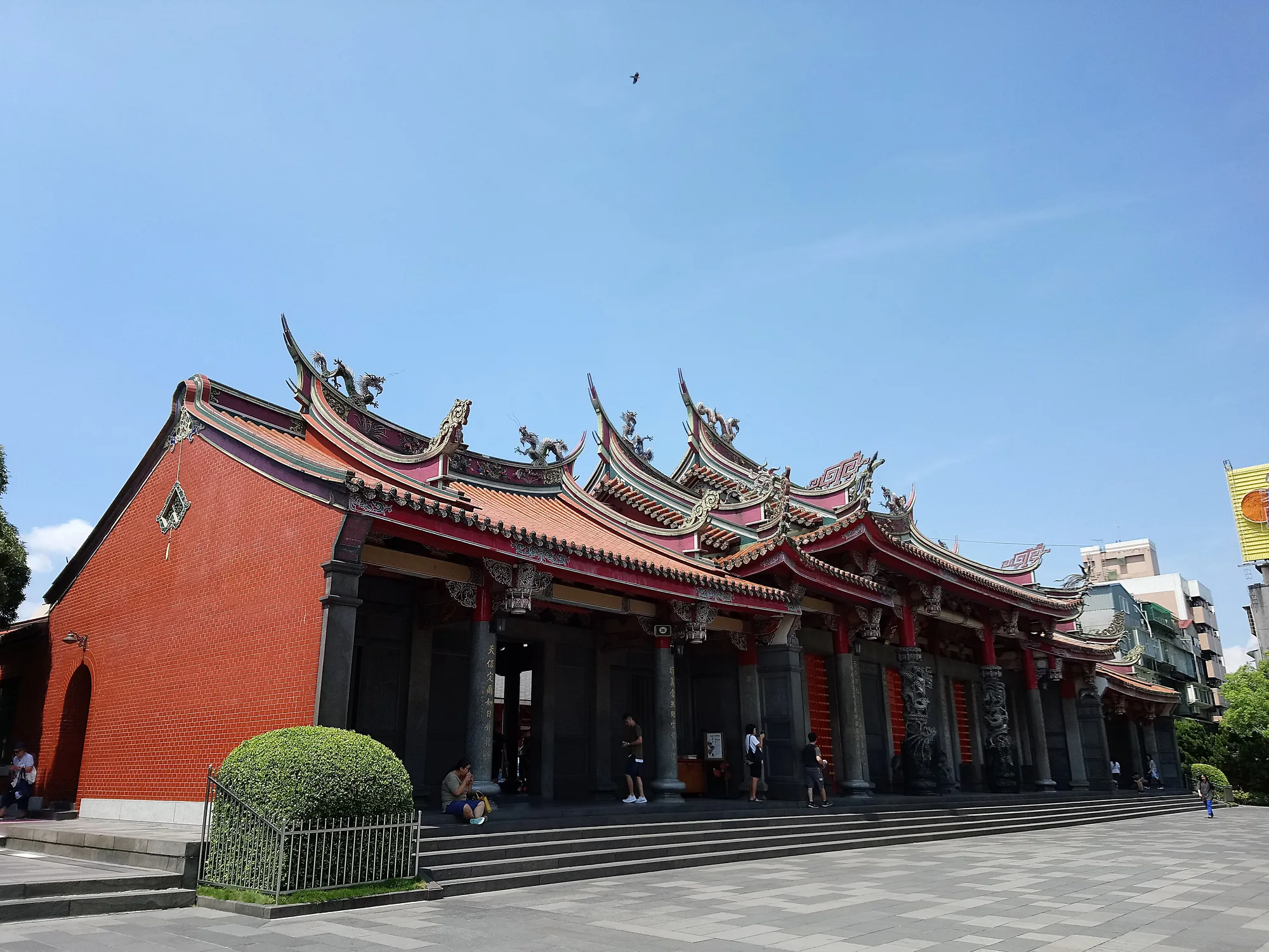
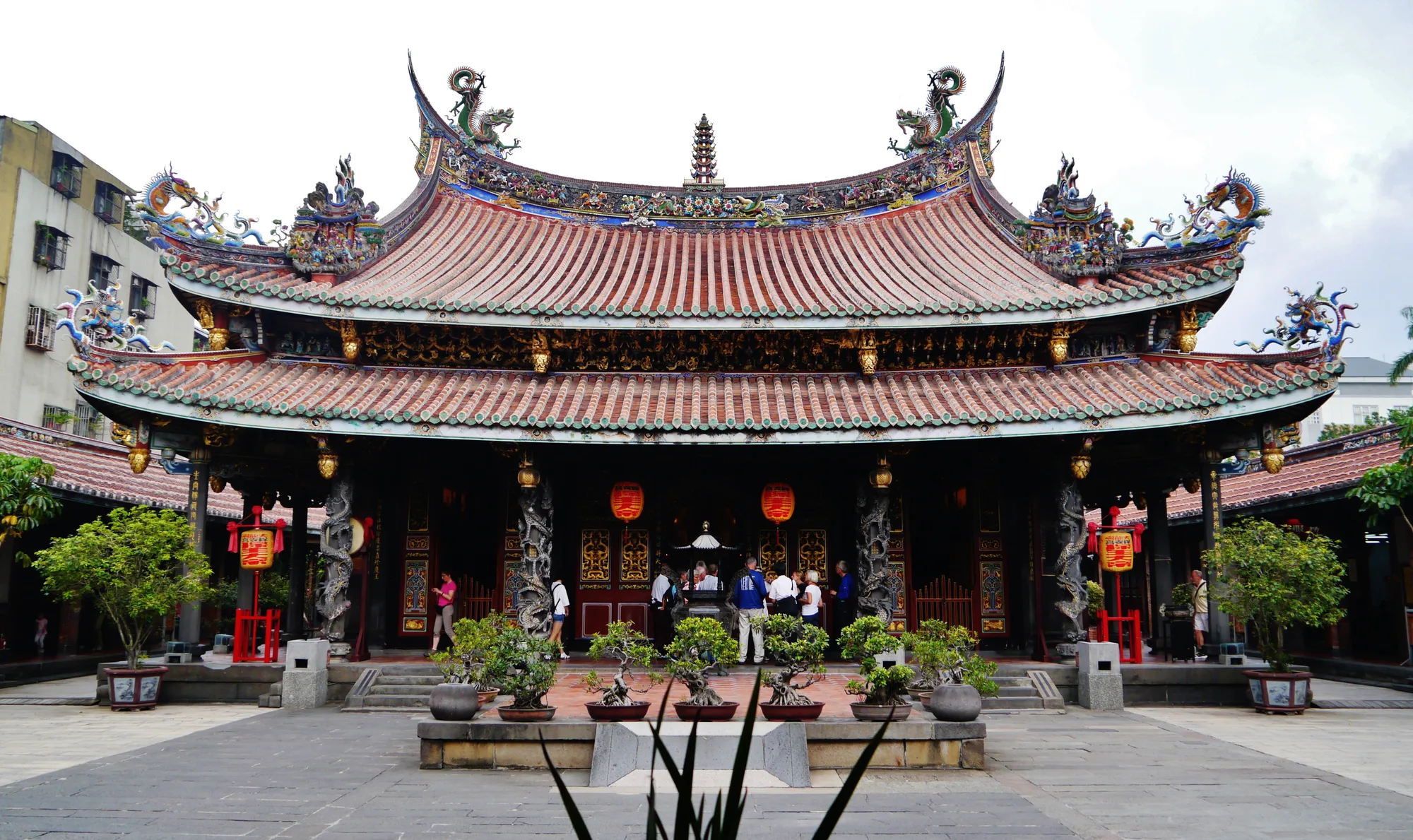
Though smaller and less famous than nearby Longshan Temple, Qingshan Temple is rich in craftsmanship and rewards close looking. It is a multi-storey complex packed into the old street frontage, with elaborately carved stone columns, wooden brackets, and a roofline crowded with the swooping dragons, phoenixes, and figurines of jiannian (cut-and-paste ceramic) work typical of southern Fujianese temple building.

Inside, the dim, incense-scented halls are layered with gilded carving, deity statues, and donor plaques accumulated over more than a century and a half. Because it remains a genuine neighbourhood temple rather than a major tourist site, the atmosphere is quiet and devotional on ordinary days — a contrast that many visitors find more affecting than the busier landmarks.


  • Carved stone columns and intricate wooden brackets
  • Jiannian cut-ceramic figures crowding the roofline
  • Gilded interior halls layered over 150-plus years
The red-walled Xingtian Temple main hall in Taipei with its ornate swallowtail roof under a blue sky
Photo: 寺人孟子 · CC BY-SA 4.0 · Wikimedia Commons

The festival

The temple is best known for the King of Qingshan Festival, held annually around the 20th to 23rd days of the 10th lunar month and centered on the deity’s birthday. Often called the Great Bangka Sacrificial Ceremony, it is one of Taipei’s three biggest annual temple fairs.

During the festival, neighboring temples join in nighttime inspection processions through the old streets, filling Wanhua with palanquins, performers, and crowds — a vivid window into living folk religion.

The ornate main hall of Dalongdong Bao'an Temple in Taipei, with a multi-tiered swallowtail roof, dragon ornaments and red lanterns
Photo: Zairon · CC BY-SA 4.0 · Wikimedia Commons

Why go

Wanhua is one of Taipei’s most historic-feeling districts, and Qingshan Temple fits naturally into an older Taipei walking day. It’s especially satisfying if you like temples for architecture and atmosphere, not just for photos.

Pair it with one heritage street stop and one food mission and you have a complete evening without overplanning.

How to pair it

Treat this as part of a Wanhua loop rather than a standalone stop. Keep the walking distance short and let the neighborhood texture do the work.

  • Longshan Temple → Bopiliao heritage lanes → Qingshan Temple → snack/dinner
  • Wanhua heritage afternoon → Ximending neon contrast at night

FAQ 常見問題

Quick answers to common planning questions.

Which deity is worshipped here?
The King of Qingshan (Lingan Zunwang), a deity revered for warding off disease and upholding justice. The temple was founded in the mid-1850s in Bangka (Wanhua).
When is the big festival?
The King of Qingshan Festival runs roughly the 20th–23rd days of the 10th lunar month, around the deity’s birthday. It’s one of Taipei’s three largest temple fairs.
How do I get there?
The temple is at No. 218, Section 2, Guiyang Street, Wanhua, about a 500-meter walk from Longshan Temple Station on the MRT Blue line.
Is there an entrance fee?
No. Like other temples in the area it’s free to visit; just be respectful inside this active place of worship — keep your voice down, don’t point at the deities, and ask before photographing people at prayer.
How does it compare to Longshan Temple?
Longshan is bigger, busier, and more famous; Qingshan is smaller and quieter, with intricate carving and a more devotional, neighbourhood feel. Many visitors find that seeing both — a short walk apart in Wanhua — gives a fuller picture of old Taipei’s temple culture.

Helpful links 連結

Official pages and references for planning details.

Keep exploring 繼續逛

Hand-picked next reads to make your Taipei plan smoother.

Wanhua: old Taipei texture, temples, and historic street life

Wanhua: old Taipei texture, temples, and historic street life

Taipei’s oldest district: temple atmosphere, heritage blocks, and everyday street scenes—best explored slowly with snacks and short walks. Anchored by Longshan Temple, it’s where the city’s lived-in history is most palpable.

Read more →
Ximending: youth culture, neon nights, and easy street food

Ximending: youth culture, neon nights, and easy street food

Taipei’s most famous pedestrian shopping area—bright signage, pop culture, and a steady stream of snacks and late-night eats. Compact, walkable, and endlessly photogenic, it’s the city’s easiest ‘Taipei at night’ to dive into on day one.

Read more →
Longshan Temple: Taipei’s living heritage in Wanhua

Longshan Temple: Taipei’s living heritage in Wanhua

Founded in 1738 in Taipei’s oldest neighborhood, Longshan Temple is a working Buddhist-and-Taoist shrine wrapped in ornate Taiwanese craftsmanship—and the perfect gateway into the old streets of Wanhua.

Read more →
Bopiliao Historical Block: heritage lanes in Wanhua

Bopiliao Historical Block: heritage lanes in Wanhua

A preserved Qing-era commercial street beside Longshan Temple, with red-brick arcades layering Fujianese, Qing, Japanese-colonial and Western styles. A photogenic, free heritage stop—best paired with the temple and slow Wanhua wandering.

Read more →
Nanjichang Night Market: a local Taipei market for serious snack hunters

Nanjichang Night Market: a local Taipei market for serious snack hunters

A local, non-touristy night market tucked into a narrow alley near public housing in Wanhua/Zhongzheng—named after a former airport that once stood nearby. Great if you’ve done the big-name markets and want a grittier, more neighborhood vibe.

Read more →
Temples in Taipei: etiquette, timing, and what to notice

Temples in Taipei: etiquette, timing, and what to notice

A respectful, beginner-friendly guide to visiting Taipei’s temples—what to wear, how to move, and how to appreciate the details without feeling awkward.

Read more →

Ready to plan your next stop? 下一站

Start with a simple loop: one neighborhood stroll, one iconic sight, and one night market. Taipei rewards balance.

Tip: hours, prices, and seasonal schedules can change. When something matters (like a museum ticket or a special exhibition), check the official listing before you go.